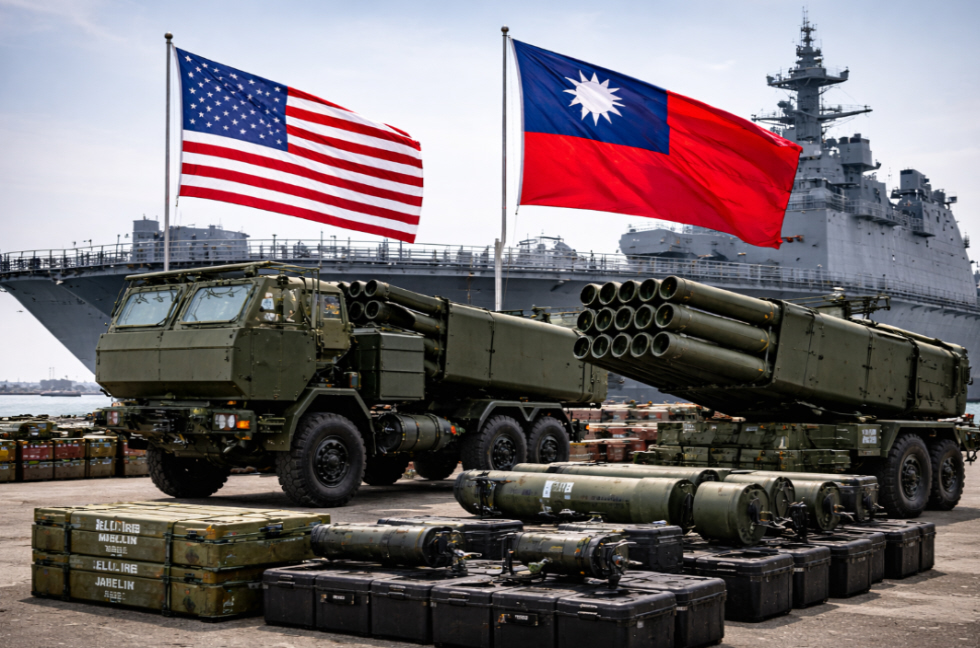
The United States has announced plans to supply Taiwan with a record-breaking arms package valued at approximately $11.1 billion, marking the largest U.S. military assistance package to the island to date, according to Taiwan’s Ministry of National Defense. The proposed package includes HIMARS missile systems, artillery howitzers, anti-tank missiles, and drones, and has now entered the formal notification phase to the U.S. Congress, a mandatory step under American law before any such transfer can be finalized.
The U.S. Department of Defense stated that the arms delivery serves America’s national, economic, and security interests, and is intended to support Taiwan’s efforts to modernize its armed forces and maintain what Washington describes as a credible defensive capability. U.S. officials emphasized that the package is consistent with long-standing U.S. policy in the Indo-Pacific region and aligns with commitments under the Taiwan Relations Act, while reaffirming that Washington’s official position on Taiwan’s political status remains unchanged. In Taipei, presidential spokesperson Karen Kuo said Taiwan will continue advancing its defense reforms and strengthening the resilience of society as a whole.
She stressed that the goal is to safeguard public security and preserve regional stability, reiterating the government’s determination to defend its democratic system and way of life. Kuo expressed appreciation for U.S. support and underscored that Taiwan seeks to secure peace through strong defensive capabilities rather than through confrontation. The announcement comes amid heightened tensions in the Taiwan Strait, where China considers the island part of its territory and has repeatedly opposed foreign military cooperation with Taipei.
At the same time, both Taiwan and the United States have emphasized that their actions are defensive in nature and aimed at deterrence, with the stated objective of preventing conflict and maintaining strategic balance in the region. Analysts note that the arms package highlights the growing geopolitical importance of the Indo-Pacific and Taiwan’s central role in global technology supply chains and regional security frameworks.
They also caution that developments in this area require careful diplomatic language and restraint to avoid unnecessary escalation. In this context, decisions made in Washington, Taipei, and Beijing will continue to be closely watched by the international community, with regional stability remaining a shared priority.