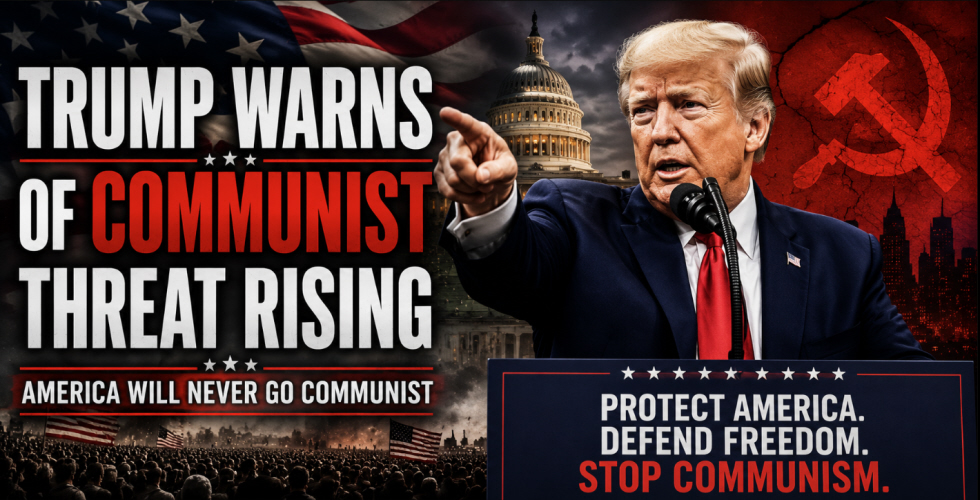
President Donald Trump has intensified his warnings about what he describes as a growing communist threat inside the United States. During recent public appearances, Trump portrayed communism as a dangerous ideology capable of destroying the country’s political, economic, and social foundations. His statements were directed primarily at progressive Democrats and candidates associated with the party’s left wing. The remarks signal that ideological confrontation will become a major theme ahead of the midterm elections. Trump compared communism to a cancer that must be removed before it can spread throughout American society.
He argued that the ideology initially attracts voters by offering appealing promises, including free housing, rent assistance, food, and other government-funded benefits. According to the president, those promises may appear attractive but ultimately lead to economic collapse and widespread suffering. His language was designed to present the political debate as a struggle over the nation’s future. The president has repeatedly linked progressive Democratic proposals with socialism and communism, even though Democratic leaders reject those characterizations.
Trump’s strategy appears intended to unite conservative voters by portraying his political opponents as supporters of a radical transformation of the United States. The message has been especially prominent following victories by progressive candidates in several Democratic primary contests. Republicans believe the argument could motivate their political base during the approaching elections. Trump warned that a communist political system would eventually produce poverty, instability, violence, and the destruction of individual freedom. He claimed that people could lose their homes, livelihoods, and personal security if such an ideology gained influence in the country.
These dramatic predictions have generated significant attention across the American media. Critics argue that the president is using extreme language to create fear among voters. The Democratic Party includes a broad range of political positions, from moderate centrists to democratic socialists and progressive activists. Most Democratic officials do not identify themselves as communists and strongly dispute Trump’s description of their policies. They maintain that proposals involving healthcare, housing, education, and social assistance operate within a democratic and market-based system.
The dispute therefore reflects conflicting interpretations of government’s proper role in American life. For Trump and his supporters, the use of the word communism carries powerful historical and emotional meaning. It recalls the Cold War, authoritarian governments, state-controlled economies, and restrictions on political freedom. By connecting Democrats with that history, Trump seeks to frame the opposition as a threat rather than simply a competing political party. The approach transforms an electoral disagreement into a much larger ideological confrontation.
The president’s message may prove effective among voters who already believe the federal government has become too large and intrusive. It may also resonate strongly with communities whose families fled communist governments in Latin America, Europe, or Asia. However, political strategists acknowledge that the rhetoric may have less influence among independent and younger voters. Its success will depend largely on economic conditions and the concerns dominating the election campaign. Democrats have accused Trump and Republican leaders of using ideological labels to distract attention from issues such as housing costs, healthcare, wages, and affordability.
They argue that expanding certain public programs does not represent an attempt to replace capitalism or democratic government. Instead, they describe their proposals as reforms intended to reduce inequality and provide greater economic security. The disagreement is expected to deepen as the campaign progresses. Trump has promised to use his political influence and presidential authority to prevent what he considers the advance of communism in the United States.
He has presented himself as the defender of private property, free enterprise, religious liberty, and traditional American values. Supporters view this position as a necessary response to the Democratic Party’s progressive wing. Opponents see it as an effort to delegitimize ordinary political competition through inflammatory accusations. The renewed debate demonstrates how deeply divided American politics has become over ideology, government, and national identity.
Trump’s warnings will likely remain central to Republican messaging as the midterm elections approach. Whether voters interpret them as a legitimate warning or exaggerated campaign rhetoric could help shape the political outcome. What is already clear is that the battle over the meaning of communism has returned forcefully to American public life.