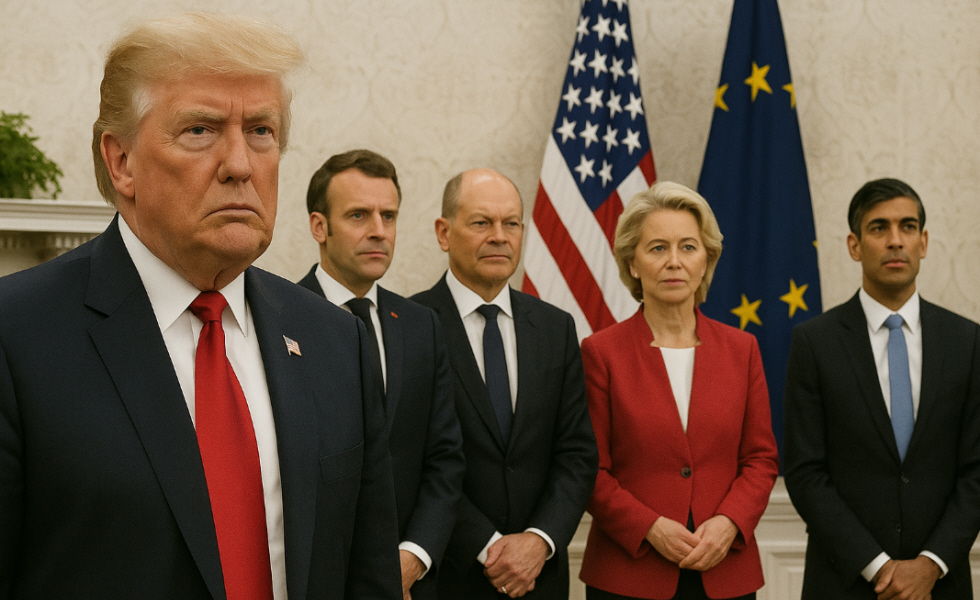
President Donald Trump has once again stirred international controversy by deciding not to personally receive several of the main European leaders who arrived in Washington for the recent summit on Ukraine. Instead, he delegated the official welcome to the White House Chief of Protocol, Monica Crowley, a move widely interpreted as a diplomatic snub toward some of the United States’ closest partners. The exception was Ukrainian President Volodymyr Zelensky, whom
Trump did receive directly and with a high-level meeting. This contrast made it clear that, for the Trump administration, the immediate priority is Ukraine and the possible outcome of the conflict with Russia, while the relationship with other European allies seems to take a back seat. At the same time, the White House confirmed that an elaborate reception is being prepared for Vladimir Putin in Alaska.
According to reports, the event will include an Air Force flyover and a ride in the presidential limousine known as The Beast. This plan has been viewed as a signal of closeness toward Moscow, and as a direct message that Trump seeks to strengthen bilateral channels with Russia, even over the traditional multilateral frameworks of NATO and the European Union. Criticism was swift. Political analysts in Europe argued that this stance reflects a profound shift in U.S. foreign policy, where the White House appears to value its relationship with Russia more than the transatlantic consensus.
For many observers, this approach undermines European allies’ confidence in Washington’s reliability as a security guarantor. At the same time, Trump reiterated that, under his leadership, there will be no U.S. troops deployed on Ukrainian soil. However, he opened the door to possible air support and to the creation of a “security guarantees” structure that would function parallel to NATO, but without formally including Ukraine as a member.
According to Trump himself, this formula would allow for protection and assistance without dragging the United States into a direct military commitment that could escalate into a larger war. The situation leaves a scenario full of uncertainties, as Trump shows a willingness to negotiate with Putin while simultaneously supporting Zelensky, but European leaders feel they have been relegated to a secondary role. For many diplomats, the gesture of not receiving them in person is more than a matter of protocol: it is a political statement that redefines Washington’s priorities at a critical moment for global security.