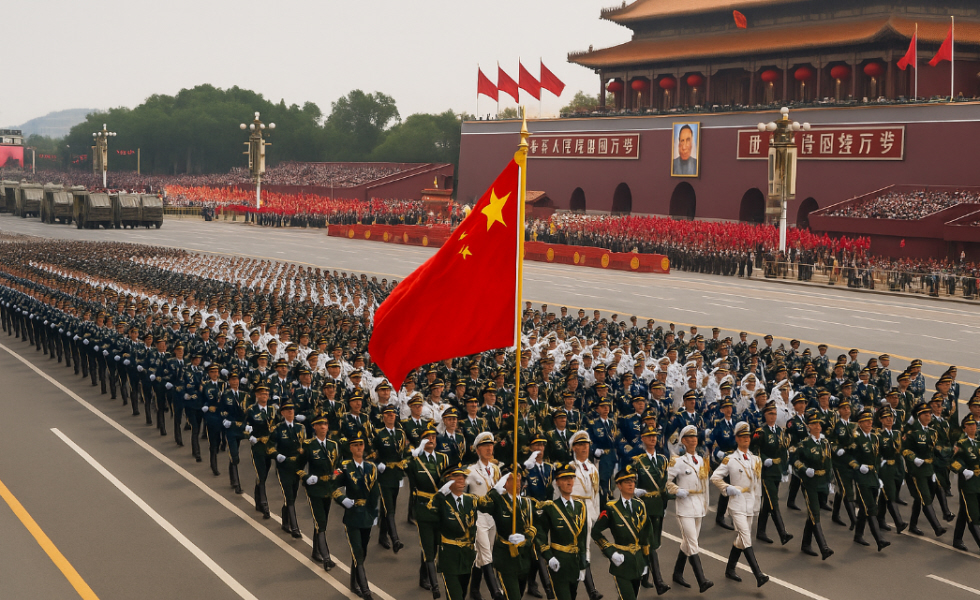
Chinese President Xi Jinping delivered a forceful message during a massive military parade in Beijing, declaring that the world is at a crossroads between peace and war. The event, staged in Tiananmen Square to mark the 80th anniversary of the end of World War II in Asia, showcased China’s military might with displays of hypersonic missiles, advanced drones, and thousands of troops marching in precise formation.
The spectacle was attended by high-profile allies, including Russian President Vladimir Putin and North Korean leader Kim Jong Un, underscoring the emerging alignment of powers that openly challenge Western influence on the global stage. In his address, Xi framed the parade not only as a commemoration of past victories but also as a statement of China’s readiness to safeguard what he described as a “new era of global order.”
He warned that escalating tensions, economic sanctions, and confrontations in key regions could tip the balance toward conflict unless nations chose cooperation over confrontation. “The world must decide whether to pursue peace or succumb to war,” Xi said, adding that China would remain committed to defending its sovereignty, security, and development interests.
The parade featured an array of cutting-edge military hardware, including the latest DF-27 hypersonic missile system, designed to evade missile defenses, and swarms of combat drones capable of autonomous strikes. Analysts noted that the scale and technological sophistication of the display were intended to send a clear signal to both domestic and international audiences: China is prepared to assert its power and protect its strategic interests, particularly in contested areas like the South China Sea and Taiwan Strait.
For many observers, Xi’s words echoed broader concerns about a fragmented global order. The presence of Putin and Kim at the event highlighted the consolidation of ties among Beijing, Moscow, and Pyongyang, creating what some analysts describe as an emerging “axis of upheaval.” Western governments responded with criticism, warning that the militaristic tone of the parade and Xi’s rhetoric risked fueling tensions at a time when the international community faces multiple overlapping crises, from economic instability to armed conflicts in Eastern Europe and the Middle East.
Domestically, the parade was framed as a celebration of national pride and resilience, reinforcing Xi’s image as a strong leader at a pivotal moment in Chinese politics. State media praised the event as evidence of China’s rise as a global power capable of shaping international rules and norms. Internationally, however, the message was more unsettling: a reminder that the choices made by world leaders in the coming years could determine whether the future leans toward cooperation and stability or descends further into rivalry and conflict.