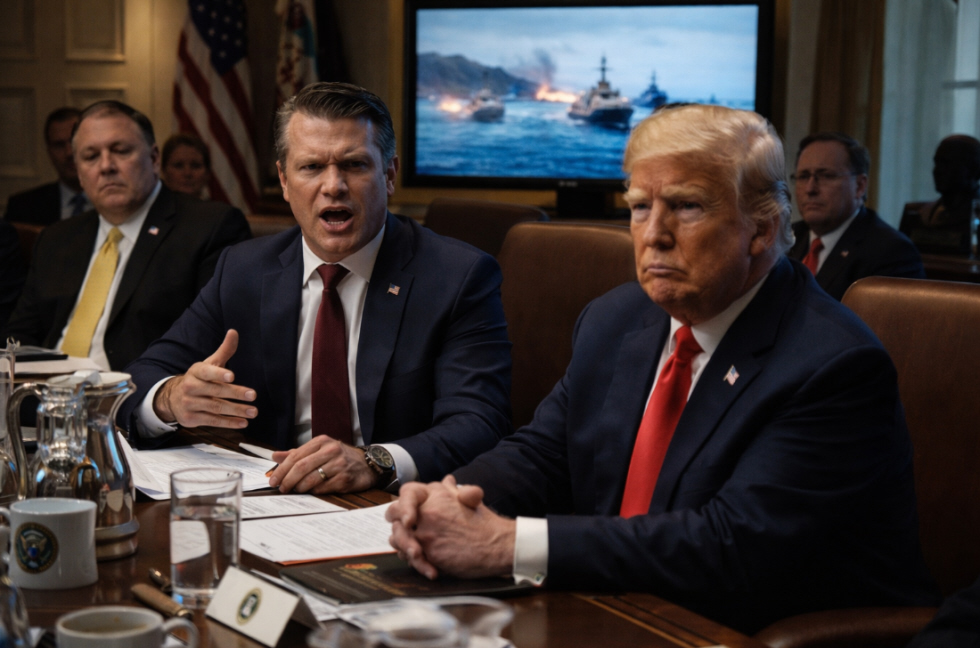
The U.S. Secretary of Defense drew significant attention during a White House meeting while addressing the ongoing conflict with Iran. In the middle of his remarks, the tone shifted toward direct criticism of the media. His statements reflected a firm defense of the administration’s military strategy. The moment quickly captured both political and media attention.
During his intervention, the Pentagon chief strongly defended the military operations underway, emphasizing their speed and effectiveness. However, a large portion of his message focused on challenging how the conflict is being reported. In his view, public coverage does not fully represent the scope of the actions taken. This created a rare moment of confrontation in that setting. The remarks were delivered in the presence of the president and other cabinet members, amplifying their impact.
Rather than limiting his comments to technical or operational details, the official adopted a more political tone. The combination of military defense and media criticism defined the moment. It marked a break from the usual protocol. In the context of an evolving international conflict, such statements carry significant weight. The relationship between government and media becomes a key factor in shaping public perception.
The narrative of war is not only determined on the battlefield, but also in the information space. This adds another layer of complexity to the situation. The message also included praise for presidential leadership, reinforcing the idea of a clear and decisive strategy. The administration aims to project control and determination in the face of the crisis. However, the tone of the remarks led to mixed interpretations.
Some see strength, while others view it as unnecessary confrontation. Politically, the episode highlights growing polarization around how the war is being covered. Tensions between officials and the media are not new, but they are intensified by the military context. Every public statement becomes part of a broader national debate. The balance between information and narrative becomes increasingly delicate.
Meanwhile, the conflict in the region continues to evolve, carrying both military and diplomatic implications. Decisions made in Washington have global consequences. In this environment, official communication plays a strategic role. It is not only about informing, but also about shaping international perception.
The episode underscores that the conflict is being fought not only on the ground, but also in the political and media arenas. The words of leaders can shape the narrative as much as military actions. In a time of heightened tension, every message carries greater significance. Its impact can extend far beyond the moment it is delivered.