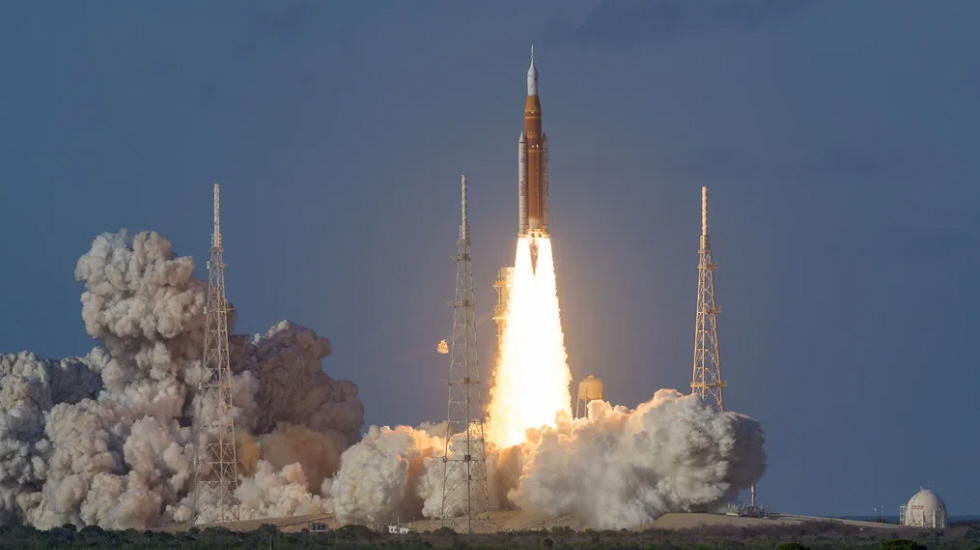
The Artemis II mission successfully launched from the Kennedy Space Center in Florida, marking the historic return of astronauts toward lunar orbit after more than five decades. The launch took place amid global anticipation, with millions of people watching the event live. This moment symbolizes a new chapter in modern space exploration. Humanity once again looks at the Moon as a real and reachable destination.
The powerful Space Launch System rocket propelled the Orion spacecraft beyond Earth’s atmosphere with remarkable precision. The technology used in this mission represents decades of scientific advancement and international collaboration. From the very first seconds of liftoff, everything proceeded within expected parameters. The operation was considered a technical success from the start. On board are four astronauts representing a new generation of space explorers. The crew includes diverse and highly trained individuals prepared to face the challenges of deep space. This team also reflects an evolution in inclusion within space missions.
Each member plays a crucial role in the mission’s development. Artemis II is not intended to land on the Moon, but to orbit it and return safely to Earth. This step is essential to validate systems ahead of future crewed lunar landing missions. The mission serves as a full-scale rehearsal for what lies ahead. It is a critical test to ensure safety and efficiency. During its journey, the Orion spacecraft will perform complex maneuvers around Earth before heading toward the Moon.
These maneuvers allow trajectory adjustments and ensure that all systems function properly. Every phase has been carefully planned by engineering teams. Precision is essential in missions of this magnitude. The entire mission is expected to last approximately ten days, including the round trip. During this time, astronauts will evaluate the spacecraft’s performance under real conditions. Navigation, communication, and life support systems will be closely monitored.
All collected data will be vital for future missions. This launch marks the first crewed flight beyond low Earth orbit since the Apollo era. The significance of this achievement is not only technological, but also symbolic for humanity. It represents a renewed ambition to explore beyond our planet. A step that reshapes the future of space exploration. The Artemis program aims to establish a sustained human presence on the Moon in the coming years.
This includes building infrastructure and preparing for more complex missions. The Moon is envisioned as a strategic base for future exploration. Mars stands as the next great destination on the horizon. Beyond its scientific impact, the mission also carries strong geopolitical and technological implications. Major powers see space exploration as an opportunity for global leadership.
Competition and cooperation intertwine in this new landscape. Space once again becomes a central axis of development. The success of the launch reinforces confidence in the systems developed by NASA and its partners. Every component has been tested under extreme conditions prior to this mission. Real-flight validation is the final step toward full reliability. Space engineering reaches one of its most demanding milestones here. The safe return of the crew will be just as important as the journey to the Moon.
Reentry into Earth’s atmosphere represents one of the most critical phases of the mission. All systems must operate with absolute precision. Safety remains the top priority. With Artemis II, humanity is not only returning to the Moon, but redefining its ambition in space.
This mission marks the beginning of a new era of sustained exploration. The focus is no longer just reaching destinations, but staying and advancing. The future of space exploration has begun once again.