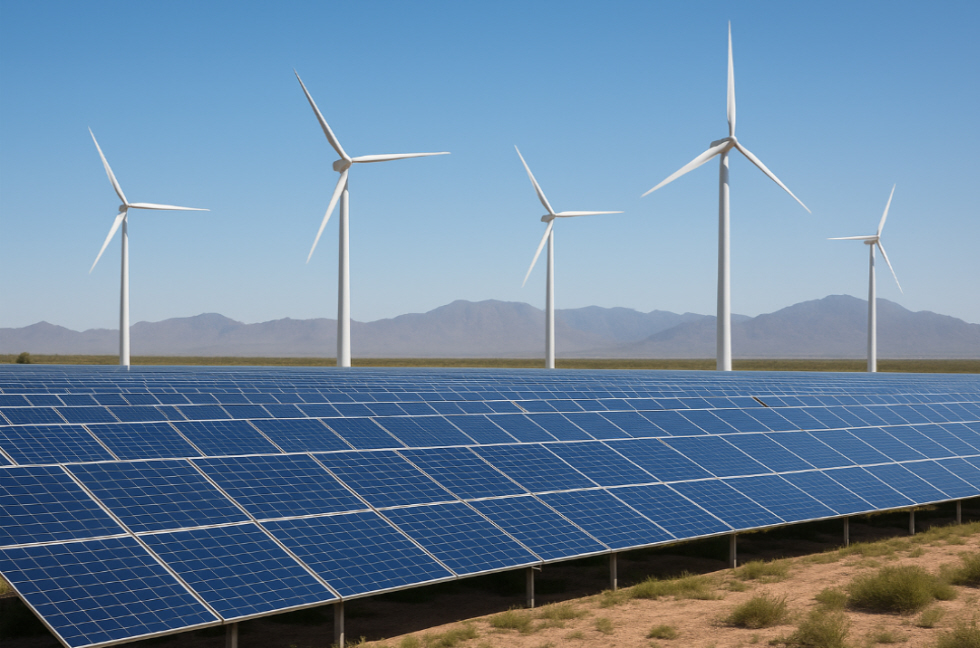
In the first half of 2025, China completely met the growth in its electricity demand through renewable energy generation, thereby reducing coal power generation and emissions. According to a report, the People’s Republic accounted for 55 percent of the global increase in solar power and 82 percent of the growth in wind energy—clear evidence of Beijing’s current leadership role in the energy transition, it said.
According to the report Global Electricity Mid-Year Insights 2025 by the think tank Ember, solar power generation in China rose by 168 terawatt-hours (TWh) (up 43 percent) compared to the same period last year, while wind power increased by 79 TWh (up 16 percent). Solar’s share in the electricity mix grew to 11.5 percent, and wind reached 12 percent. At the same time, coal power generation fell by 56 TWh (down 2 percent), and emissions from the power sector dropped by 46 million tons of CO₂ (down 1.7 percent). New solar records were set worldwide: among the 20 largest solar power producers, seven countries—Hungary, Greece, the Netherlands, Pakistan, Spain, Australia, and Germany—each generated 20 percent or more of their electricity from photovoltaic power in the first half of 2025.
Hungary led with just under 30 percent. Greece and the Netherlands each surpassed 25 percent. Pakistan recorded the biggest leap, from 4.4 percent (in the first half of 2021) to 21.9 percent (first half of 2025), driven by a rooftop solar boom in response to high electricity prices. China accounts for two-thirds of global photovoltaic expansion China is also far ahead in capacity expansion: 380 gigawatts of photovoltaic capacity were added worldwide in the first half of this year, with China representing 67 percent of that. Globally, solar and wind energy exceeded demand growth—with global electricity demand rising by 2.6 percent (to 369 TWh), solar power (up 306 TWh or 31 percent) and wind (up 97 TWh or 7.7 percent) contributed more than enough.
For the first time, renewables surpassed coal in the global electricity mix (34.3 percent versus 33.1 percent). However, nuclear power generation also increased by 33 TWh (up 2.5 percent) worldwide in the first half of the year, maintaining its 9.1 percent share of the electricity mix. China made the largest contribution (up 24 TWh). Higher CO₂ emissions in the U.S. and the EU The contrast with other major regions highlights China’s exceptional role: in the U.S., renewable growth has not kept pace with demand.
Coal filled the gap, and emissions rose by 33 million tons of CO₂. In the EU, weak wind and hydropower output led to increased electricity generation from gas and, to a lesser extent, coal. Emissions rose by 13 million tons. Ember describes this as a turning point: solar and wind power are now growing fast enough to meet additional global demand, and fossil fuel power generation is nearing its peak.