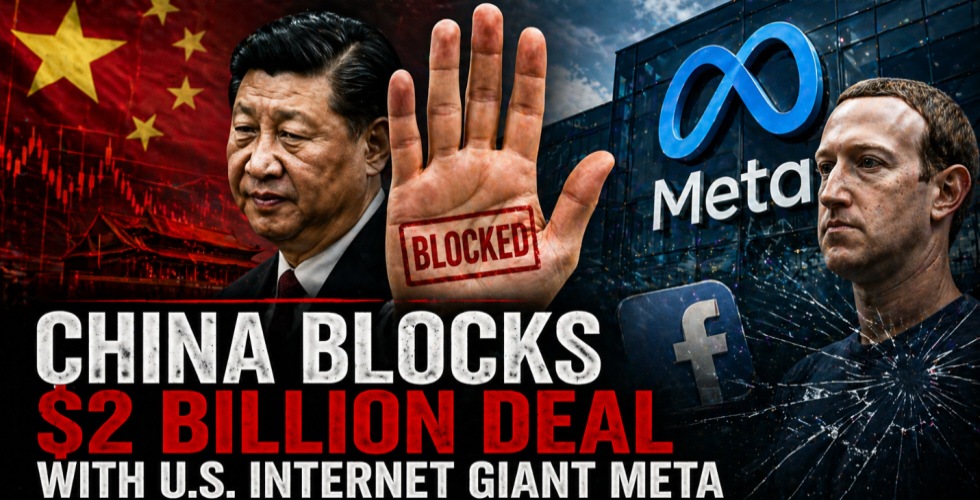
China has intensified its strategy of economic and regulatory pressure on major foreign technology companies, especially those linked to the United States. Amid growing geopolitical rivalry with Washington, Beijing has decided to use its internal control tools more aggressively to defend its strategic interests. This time, the focus falls on Meta, the parent company of Facebook, in an operation valued at billions of dollars. The blocking or freezing of a deal worth nearly two billion dollars has generated a strong reaction in international markets. Although the full details of the process have not been officially disclosed, the political message is clear.
China is showing that it responds not only with diplomatic speeches, but also with economic decisions that directly affect global giants. Meta represents much more than a technology company. Its influence in social media, digital advertising, artificial intelligence, and hardware development makes it a strategic player in global technological competition. Although Facebook does not operate freely in mainland China, the company maintains indirect commercial interests in the region through international advertising, devices, and business partnerships.
For Beijing, allowing or blocking operations of this kind has become a geopolitical negotiation tool. Regulatory approvals are no longer analyzed only through economic logic, but also through the balance of international power. Every approval or every delay can be interpreted as a political signal to Washington. China has rapidly expanded its economic policy toolbox in recent months. Antitrust controls, data restrictions, foreign investment supervision, and new cybersecurity requirements are all part of this new pressure architecture. What once seemed like an administrative process now also functions as a strategic instrument.
The United States has imposed severe restrictions for years against Chinese companies in sensitive sectors such as semiconductors, telecommunications, and artificial intelligence. Washington argues that protecting its technological innovation is a matter of national security. Beijing responds with the same logic: defending its economic sovereignty and avoiding excessive dependence on foreign actors. The Meta case fits precisely within that logic of geopolitical reciprocity. It is not only about a business contract, but also a signal within the silent war for control of twenty-first-century technology.
Every move between both powers affects not only the companies involved, but also global investment and supply chains. Investors are watching these movements with growing concern. When regulatory decisions mix with geopolitical disputes, market predictability is drastically reduced. International capital needs legal stability, but rivalry between Washington and Beijing introduces a political variable that is difficult to calculate. Meta also faces an important symbolic challenge. Although it is one of the most powerful companies in the digital world, its relationship with China has always been complex.
Facebook has remained blocked in the country for years, but the company has tried to maintain indirect commercial bridges. Every new obstacle confirms that this door remains under strict political control. For China, controlling the access of foreign technology giants also has an internal dimension. Data protection, narrative control, and information sovereignty are essential parts of the Chinese political model. Allowing excessive expansion of Western companies within that ecosystem would be seen as a strategic vulnerability. President Xi Jinping has reinforced the idea of technological self-sufficiency as a national priority. From chips to digital platforms, the goal is to reduce structural dependence on Western suppliers.
In that context, limiting the power of companies like Meta is not an exception, but part of a much broader long-term strategy. At the same time, Chinese companies such as Tencent, Alibaba, and ByteDance also face international pressure, especially in the United States and Europe. TikTok has become the most visible example of how politics can completely redefine the future of a global platform. The technology war no longer clearly separates business from diplomacy. Competition between the United States and China increasingly resembles a new Cold War, but with algorithms instead of missiles as the main battlefield. Control over artificial intelligence, data, and digital infrastructure now defines much of international power. Private companies operate inside that invisible battlefield.
Europe watches this confrontation with a mix of concern and pragmatism. On one hand, it needs commercial stability with both powers; on the other, it fears being trapped between two rival technological blocs. Every blockade, sanction, or restriction forces European governments and companies to recalculate their own strategies. Financial markets react quickly to any sign of escalation. A simple regulatory delay can move stock prices, alter growth expectations, and change global investment decisions. In the technology sector, perception is worth almost as much as the real execution of business.
Artificial intelligence adds an even more delicate layer to this dispute. Meta, like other major American firms, is aggressively competing in the development of advanced AI models. China considers that field strategic and seeks to avoid falling behind Silicon Valley. Access to knowledge, infrastructure, and talent has become a matter of state. Beijing also knows that control of the Chinese domestic market remains an enormously valuable card. With more than one billion digital consumers, any privileged access represents a massive commercial advantage.
That is why regulatory approvals function as a form of international bargaining currency. From the American perspective, these maneuvers confirm that China uses trade as a political tool. From the Chinese perspective, Washington has been doing exactly the same thing for years under the discourse of national security. Both powers accuse each other of similar practices while deepening technological decoupling. The central question is no longer whether competition between both powers will exist, but how far that competition can continue without completely breaking the global economic architecture.
The risk of technological fragmentation is real and grows with every new restriction. Companies, governments, and consumers all end up paying the price. What is happening with Meta today could be repeated tomorrow with other companies in even more sensitive sectors. Electric vehicles, biotechnology, energy, and defense already show signs of the same dynamic. The geopolitics of the twenty-first century is no longer fought only on military borders, but also in contracts, licenses, and digital servers.