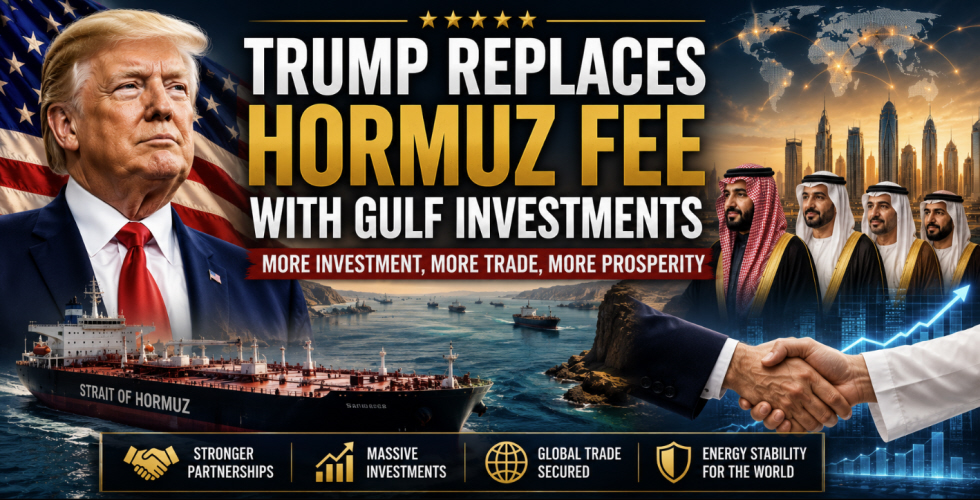
U.S. President Donald Trump surprised international markets by announcing a significant shift in his strategy regarding the Strait of Hormuz. Just one day after proposing a 20 percent fee on cargo passing through the vital waterway, he decided to abandon the idea. Instead, he will pursue economic agreements with Gulf nations. The move aims to strengthen regional cooperation without adding new costs to global trade. The decision was announced following a series of discussions that Trump described as highly productive with several Middle Eastern leaders.
According to the president, the talks created opportunities for large-scale investment and economic development. He emphasized that major financial commitments could emerge from these negotiations. Such agreements, he argued, would benefit both the United States and its regional partners. The Strait of Hormuz remains one of the most important maritime routes in the world. A significant portion of global oil and natural gas exports passes through this narrow corridor every day. Any policy affecting the waterway can have immediate consequences for international energy markets.
As a result, governments, corporations, and investors closely monitored the announcement. Trump’s original proposal to impose a 20 percent transit fee generated concern among international observers. Critics warned that the additional cost could increase transportation expenses and disrupt supply chains. Others feared the measure might create friction with key American allies in the Gulf region. The decision to withdraw the proposal was viewed by some analysts as a more practical economic approach. The president argued that investment agreements and trade partnerships could produce stronger long-term results than imposing new fees.
He suggested that Gulf-backed investments could support strategic projects and stimulate economic growth in the United States. Trump also highlighted the potential for lasting commercial cooperation. His administration expects discussions with regional partners to continue in the coming months. Despite abandoning the proposed fee, Trump maintained a firm stance toward Iran. He reiterated that vessels connected to Iranian ports or carrying Iranian goods would face restrictions under his policy framework. The measure remains part of Washington’s broader strategy of pressure against Tehran. U.S. officials believe such actions can limit specific economic activities linked to Iran.
The announcement also underscores the importance of America’s relationship with Gulf monarchies. Countries such as Saudi Arabia, the United Arab Emirates, Qatar, and Kuwait continue to play a crucial role in global energy stability. Washington views deeper cooperation with these nations as a source of economic opportunity and regional security. These partnerships have become increasingly important in today’s geopolitical environment. Financial markets responded cautiously to the news.
Some analysts believe removing the proposed fee reduces the risk of disruptions along one of the world’s most important shipping routes. Others point out that questions remain regarding the implementation of restrictions involving Iranian-linked vessels. Energy companies and shipping operators will continue monitoring developments closely. From a diplomatic perspective, the policy shift may help strengthen ties between the United States and several Gulf governments.
Replacing a fee-based approach with one centered on investment creates a less confrontational framework for cooperation. At the same time, it allows Washington to maintain influence in a strategically important region. The change could pave the way for additional economic and security initiatives. With this decision, Trump is attempting to balance economic priorities with broader geopolitical objectives in one of the world’s most sensitive regions.
His investment-focused strategy seeks to reinforce alliances while maintaining pressure on Iran. The success of the approach will depend on the agreements ultimately reached in the months ahead. For now, the announcement represents a significant shift in American policy toward the Strait of Hormuz.