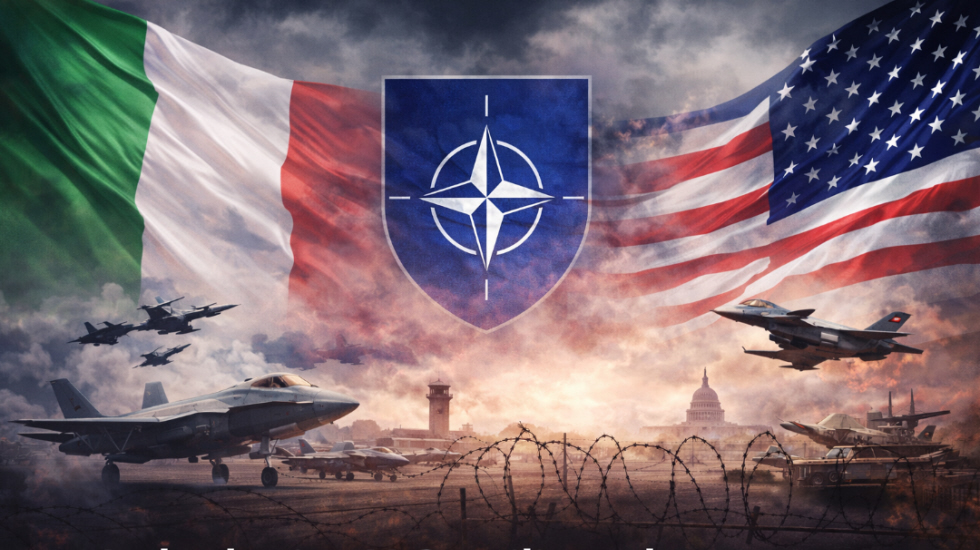
Italy denied permission for U.S. military aircraft to use one of its strategic bases in the Mediterranean, in a move that reflects current tensions within the Western alliance. The decision came in the context of operations related to the conflict in the Middle East. This development marks a sensitive moment in coordination among allies. The situation has drawn attention at multiple diplomatic levels. The incident took place at the Sigonella base in Sicily, a key hub for NATO military operations.
According to reports, Italian authorities rejected a request for U.S. aircraft to land as part of sensitive missions. Such decisions are not common within the framework of military cooperation. For that reason, the case carries particular significance. Based on available information, the denial does not represent a rupture between Italy and the United States, but rather a specific response to a particular operation. Italian authorities reportedly determined that the necessary procedures had not been fully met.
This introduces both a legal and political dimension to the decision. The measure should be understood within that context. One of the key factors behind the decision was the nature of the mission, which is believed to be linked to military actions involving Iran. Operations of this kind require clear authorization from host nations. In the absence of such approval, the use of strategic facilities can be restricted. This principle is part of the alliance’s internal framework. As a member of NATO, Italy maintains military cooperation agreements with the United States but retains sovereignty over the use of its territory.
This means that each operation must be evaluated on a case-by-case basis. The recent decision reflects that autonomy in action. It is not a general denial, but a specific assessment. The episode also highlights differences in approach between the United States and some European allies regarding the situation involving Iran. While Washington may be more inclined toward active measures, Europe has shown greater caution. This divergence influences operational decisions. Coordination becomes more complex under such conditions. From a political standpoint, Italy’s decision signals caution in the face of a potential escalation in the Middle East. The government appears intent on avoiding direct involvement in operations that could expand the conflict. This stance is shared by other European countries. Containment seems to be the priority. At a strategic level, the incident raises questions about the degree of cohesion within NATO.
While the alliance remains strong, situations like this reveal important nuances. Individual decisions by member states can influence the broader dynamic. Unity does not always mean uniformity in every action. Internationally, the case has been interpreted as a sign that Europe is seeking to define its own margin of action. The relationship with the United States remains essential, but not without differences.
This balance reflects the evolution of modern alliances. Cooperation continues to adapt to new realities. For now, both Italy and the United States maintain a stable strategic relationship despite this specific episode. However, the situation reflects a moment of adjustment in military coordination among allies. What occurred in Sigonella may signal broader shifts in the international landscape. The coming developments will be decisive.