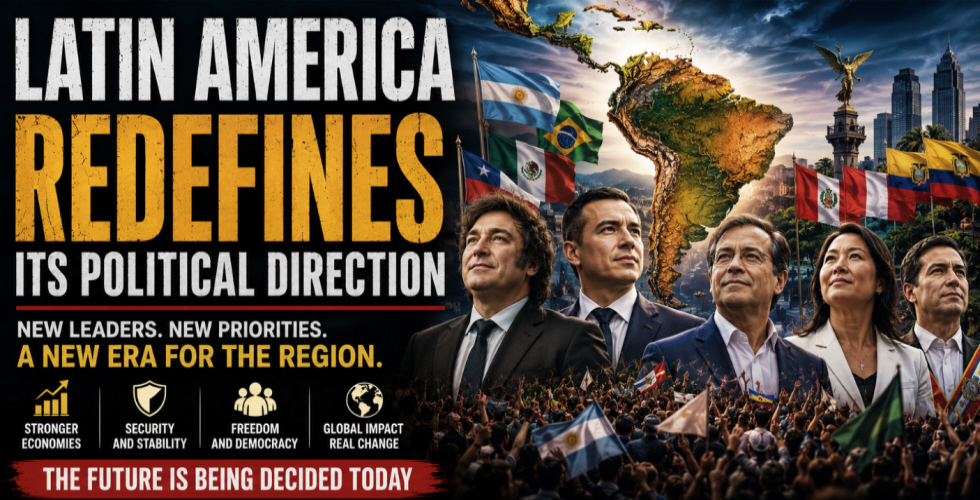
Latin America appears to be entering a new political era marked by significant shifts in voter preferences. Across the region, millions of citizens are increasingly supporting alternatives to the political movements that dominated much of the past decade. The phenomenon cannot be explained by a single ideological trend or a uniform regional movement. Each country faces unique challenges, yet several common factors help explain why voters are seeking new leadership.
Economic concerns remain at the center of public attention. Inflation, rising living costs, slower growth, and labor uncertainty have played a major role in shaping electoral outcomes throughout the region. Public security has also become a defining issue in national debates. The expansion of organized crime, drug trafficking, and violence in several countries has increased support for candidates promising tougher law-and-order policies.
In countries such as Argentina, Ecuador, Bolivia, and most recently Peru, election results have revealed growing support for center-right and conservative political movements. These leaders have successfully connected with voters dissatisfied with previous administrations. At the same time, several progressive governments are experiencing political fatigue after years in office. Difficulties in delivering on campaign promises have contributed to growing frustration among parts of their traditional support base.
However, describing these developments as a definitive ideological victory would oversimplify a far more complex reality. Latin America remains politically diverse, with each nation following its own path and responding to its own circumstances. Many analysts argue that voters are increasingly focused on practical results rather than ideological labels.
Issues such as employment, economic stability, public safety, and government efficiency are shaping political decisions more than ever before. Another important factor is the weakening of traditional political parties. In many countries, voters have shown a willingness to support new faces and alternative movements that promise to challenge established political structures.
The evolving political landscape could also reshape regional diplomacy and economic relations. New administrations may pursue different strategies regarding trade, foreign investment, and international partnerships. As additional elections approach across the region, Latin America will continue to serve as an important political testing ground.
The coming years will help determine whether these shifts represent a lasting transformation or a temporary response to current challenges. What is already clear is that Latin America is undergoing a period of political redefinition. The choices made by voters today are shaping a new regional map whose effects may influence economic, social, and geopolitical developments for years to come.
By:
Williams Valverde