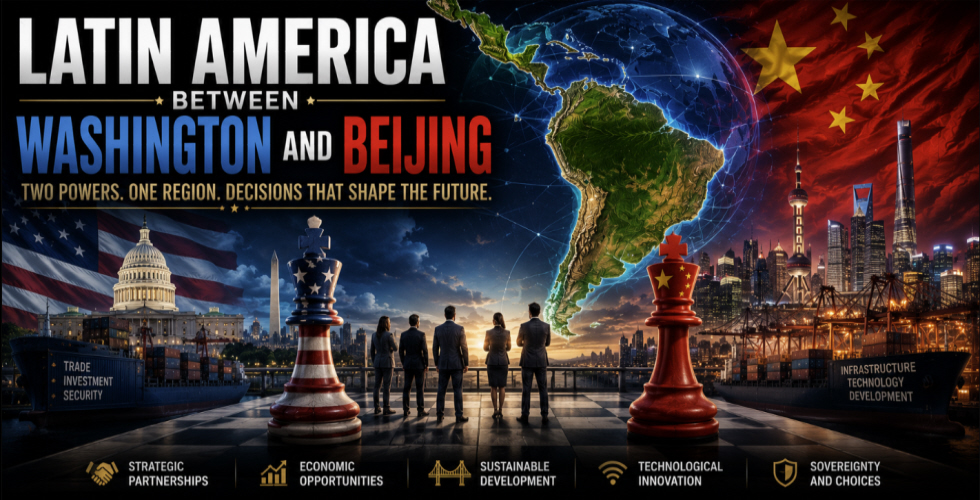
Latin America finds itself in a strategic position within the new international landscape shaped by the growing competition between the United States and China. Both powers are seeking to expand their economic, political, and technological influence throughout the region. This situation presents significant opportunities for Latin American nations. At the same time, it creates complex challenges for governments and societies. For decades, the United States has maintained considerable influence in Latin America through geographic proximity, trade relationships, and longstanding diplomatic ties.
In recent years, however, China has dramatically expanded its presence across the region. This growing involvement has altered part of the traditional geopolitical balance. The effects of this transformation continue to unfold. Chinese investments in infrastructure, energy, transportation, and mining have made Beijing a major economic partner for numerous Latin American countries. Many governments have welcomed these investments as a source of funding for projects that remained unfinished for years.
The influx of capital has stimulated key sectors of the economy. It has also sparked debates about long-term economic dependence. Meanwhile, Washington remains a fundamental player in the region. The United States continues to be one of the principal trading partners for several Latin American nations and maintains strong influence in financial, technological, and security matters. Historical ties between both sides still carry significant weight. No government can afford to overlook that reality. The competition between the two powers is not always open or confrontational.
In many cases, it takes shape through trade agreements, strategic investments, technological cooperation, and development initiatives. Latin American countries closely monitor these developments. Each decision may carry long-term consequences for their economies and international positioning. One of the region’s greatest challenges is finding ways to benefit from both relationships without becoming overly dependent on either side. Maintaining balanced partnerships requires strategic vision and strong negotiating capabilities. Diversifying alliances can strengthen regional autonomy. Achieving that objective, however, remains a difficult task.
The race for technological leadership has also become a major component of this global competition. American and Chinese companies are increasingly active in telecommunications, artificial intelligence, digital infrastructure, and advanced technology services. These sectors will play a critical role in future economic growth. Latin America must determine how it intends to participate in this transformation. Some analysts argue that the region can benefit from the rivalry between Washington and Beijing if governments focus on their own national interests.
Rather than choosing a single path, countries may be able to take advantage of opportunities offered by both powers. Such an approach would require careful planning and leadership. Greater regional coordination could also prove essential. History shows that nations whose foreign policies are driven primarily by outside interests often face limitations in achieving their development goals.
For that reason, many experts recommend that Latin America define clear priorities and strengthen its institutions. Independent decision-making will be crucial in the years ahead. The region's future may depend on that capability. The twenty-first century presents a unique opportunity for Latin America to assume a more influential role in global affairs.
Competition between the United States and China is likely to shape international politics for many years to come. The key question is how the region will respond to this challenge. Its ability to balance interests while protecting its priorities will help determine the future of generations to come.
By:
Williams Valverde