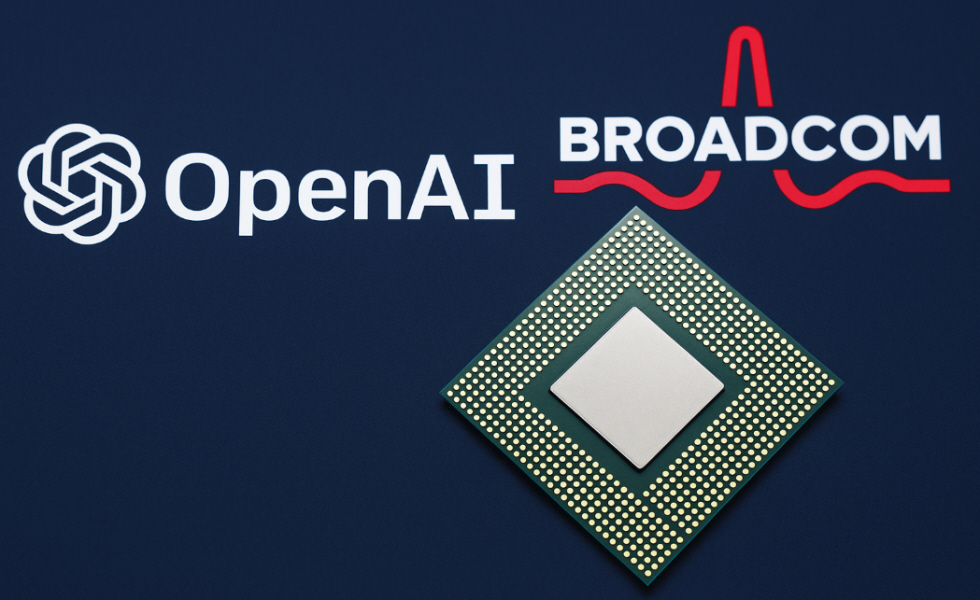
OpenAI, the company behind ChatGPT, has announced a strategic alliance with Broadcom for the development and production of its first custom artificial intelligence chips, a move that marks a turning point in its technological ambitions.
The initiative not only seeks to meet the growing demand for computing power required by next-generation models but also to reduce its heavy dependence on suppliers such as Nvidia, which until now has dominated the AI processor market. According to information revealed by the Financial Times and confirmed by various sources close to the project, mass production of these specialized chips is scheduled for 2026, with the goal of using them in OpenAI’s own operations, with no immediate plan for external commercialization.
The new processors will be designed specifically to optimize the training and inference of large-scale models, with improvements in energy efficiency, computing speed, and integration capacity for advanced data centers. The deal has generated major excitement in the stock markets, where Broadcom shares jumped by as much as 15%, fueled by news that the company has already received a chip order valued at more than $10 billion, with OpenAI as its priority customer.
Financial analysts interpret this move as a sign that OpenAI intends to consolidate its hardware infrastructure to guarantee the continuity of its expansion, avoiding the bottlenecks that in recent years have limited chip availability in the global market.
This step places OpenAI in line with giants like Google, Amazon, and Meta, which have invested in designing their own processors to strengthen competitiveness in artificial intelligence. It also enhances Broadcom’s position within the emerging AI ecosystem, making it a key player in the transition toward a future where custom chips will be critical to keeping pace with innovation.
The decision also carries geopolitical implications, as control of the semiconductor supply chain has become a strategic priority for both companies and governments amid growing tensions between the United States and China.
With this alliance, OpenAI seeks to gain technological independence, secure its scaling capacity, and maintain leadership in the development of language models and increasingly advanced artificial intelligence systems. It is a move that redefines the industry landscape and could, in the medium term, shift the balance of power in the global semiconductor market.