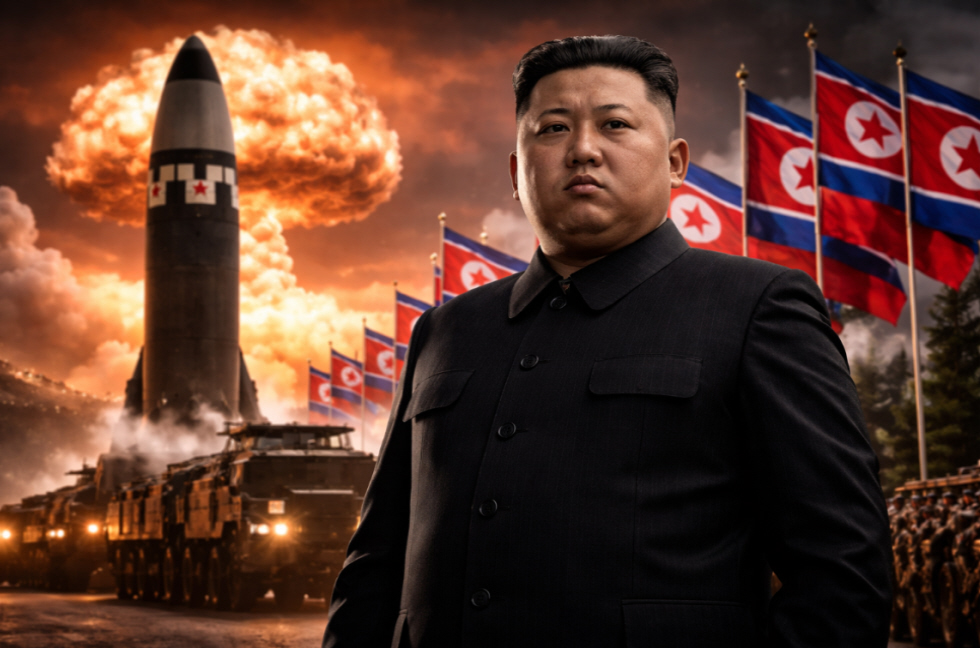
North Korea has hardened its stance on nuclear policy, signaling clearly that it has no intention of returning to denuclearization talks in the near future. Recent statements from its leadership reflect an increasingly firm view of the strategic role of its arsenal. In a global context marked by rising tensions, the message carries significant weight. The position appears to be solidifying as part of a long-term doctrine.
During an address to the Supreme People’s Assembly, the country’s leadership reaffirmed that its nuclear status is irreversible. This declaration marks a critical point in its defense policy, drawing a clear line for the international community. The idea of negotiating disarmament in exchange for sanctions relief was firmly rejected. The message seeks to eliminate expectations of concessions. The speech is framed within a broader interpretation of the international environment, where persistent threats to national sovereignty are emphasized. From this perspective, nuclear weapons are presented as a fundamental deterrent. The strategy aims to prevent external intervention.
Security is positioned as an absolute priority. References to recent conflicts in other regions have been used to reinforce this stance. These events are interpreted as evidence that only strong military capability can ensure stability. This reasoning forms part of the country’s official narrative. International developments are being used to justify domestic policy. The concept of nuclear deterrence is presented as a central pillar of the regime’s strategy.
Beyond offensive capability, the stated objective is to prevent large-scale conflict. In this view, the arsenal serves not only a military function but also a political one. Its existence reshapes the balance of power. At the same time, authorities have suggested that the development of the nuclear program has not hindered domestic economic projects. The argument is that the security provided by military strength allows resources to be directed elsewhere. This narrative aims to project internal stability. The balance between defense and development is emphasized. The international community is watching this hardened stance with concern.
Prospects for resuming denuclearization talks appear increasingly limited. Tensions could escalate further if new channels of communication are not established. The situation is becoming more complex. For their part, the United States and its allies continue to assess diplomatic and strategic options in response. Northeast Asia remains one of the most sensitive regions in the global balance of power. Any shift in dynamics could have wide-reaching consequences.
Regional stability remains at stake. The rejection of trading nuclear capabilities for economic benefits or security guarantees reinforces the idea of a long-term strategy. North Korea appears committed to maintaining its current position without concessions. This decision reshapes the framework for future negotiations.
The margin for compromise is narrowing. The current landscape reflects a hardening stance that could prolong the stalemate in international efforts to limit nuclear proliferation. Few signs of immediate openness are visible. The world is facing a scenario where deterrence once again takes center stage. Uncertainty continues to grow.